
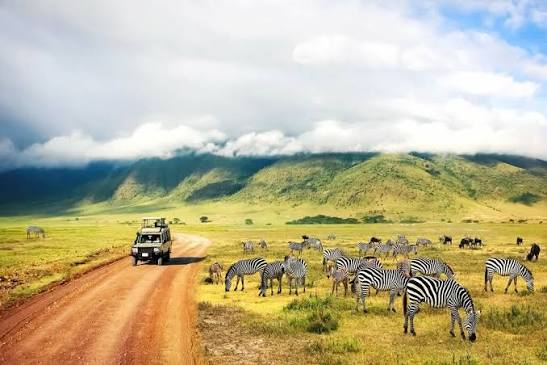
Why do roughly 1.5 million wildebeest move in a single, unbroken circle across two countries each year? The answer lies in rainfall patterns that have shaped this migration for thousands of years, and understanding those patterns is the key to planning a Kenya Tanzania Safari that actually lines up with the herds.
This FAQ-style breakdown looks at the statistics behind the Masai Mara and Serengeti ecosystem, how the two parks connect, and what a combined journey across both countries really involves.
What makes the Masai Mara and Serengeti one ecosystem rather than two?
The Masai Mara and the Serengeti are not separate wilderness areas with a coincidental shared border. They form a single, continuous ecosystem that happens to be split by the Kenya-Tanzania boundary line. The Serengeti stretches across nearly 15,000 square kilometers in northern Tanzania, while the Masai Mara forms its northern extension in Kenya. Grass, water, and migrating animals move between them freely, regardless of which country they happen to be standing in at a given moment.
This is the foundational fact that makes a combined safari logical rather than simply convenient. Visiting only one side means seeing half of an interconnected system.
How many animals take part in the Great Migration?
The herds moving through this ecosystem are dominated by wildebeest, with substantial numbers of zebra and gazelle moving alongside them. These animals don’t migrate in a straight line from point A to point B. Instead, they move in a roughly circular pattern that tracks seasonal rainfall, which in turn determines where fresh grazing appears.
This circular pattern is why the migration never truly ends. There’s no single starting point and no finish line, only a continuous rotation between Tanzania’s southern plains and Kenya’s northern reaches.
When do the famous river crossings happen?
The dramatic river crossings that most people associate with the Great Migration typically occur from July through October, when the herds push north into the Masai Mara and the northern Serengeti. This is the season when wildebeest gather at the banks of rivers like the Mara, building up in number before crossing in dense, chaotic waves.
Earlier in the year, from January through February, a different chapter unfolds on the southern Serengeti plains: the calving season. During this window, a significant portion of the wildebeest population gives birth within a short span of weeks, drawing predators who take advantage of the vulnerable young.
In June, the herds gather in the Serengeti’s western corridor before beginning their march north, while November and December mark the short rains, when the herds turn south again toward Tanzania.
How many nights does a Kenya Tanzania Safari typically require?
Ten to fourteen nights is the range most specialists recommend for a journey that covers both countries without rushing. Within that window, roughly eight nights is enough to properly experience the Masai Mara and the Serengeti together. Travelers wanting to add the Ngorongoro Crater should allow two to three additional nights, and a Zanzibar extension typically adds three to four more.
Shorter trips are possible, but they usually mean choosing one park over the other rather than genuinely connecting the two ecosystems.
How do travelers physically move between the Masai Mara and the Serengeti?
There’s no direct road or open crossing linking the two parks, since they fall under separate national park administrations in different countries. The most common route involves a light aircraft flight from the Mara, a road crossing at the Isebania border post, and a connecting flight into the Serengeti itself. An alternative path routes through Nairobi and Kilimanjaro by air.
Despite involving multiple legs, this connection is usually completed in a single day, with travelers settled into their Serengeti camp by the afternoon.
What role does the Ngorongoro Crater play in a combined itinerary?
The Ngorongoro Crater sits within Tanzania and offers something distinct from the migration itself: a dense concentration of resident wildlife visible throughout the year, independent of seasonal movement. The crater floor sits roughly 600 meters below the rim, creating a natural enclosure where species such as black rhino, lion, and elephant coexist within a contained landscape.
Because its wildlife doesn’t depend on migratory timing, the Ngorongoro Crater complements a Kenya Tanzania Safari by delivering reliable sightings regardless of when the herds happen to be elsewhere.
Does Kenya or Tanzania offer a better safari experience?
Each country brings distinct strengths rather than competing versions of the same experience. Kenya’s private conservancies around the Masai Mara allow off-road driving, night drives, and lower vehicle density per sighting. Tanzania counters with sheer scale: the Serengeti’s open plains, combined with the Ngorongoro Crater’s concentrated wildlife.
Choose a combined route if witnessing the full migratory cycle matters more to you than focusing deeply on one landscape. Choose a single-country trip if time is limited and you’d rather go deep in one place than cover more ground.
What does a typical Kenya Tanzania Safari route look like?
A common structure begins in the Masai Mara, continues into the northern Serengeti, descends into the Ngorongoro Crater, and closes either on Zanzibar’s beaches or with a final night in Nairobi or Arusha before departure. This sequencing follows the natural geography of the ecosystem rather than forcing an artificial loop.
Private journeys built around these numbers and seasonal patterns tend to deliver the most satisfying results, since timing can be adjusted around current migration reports rather than fixed departure dates.